
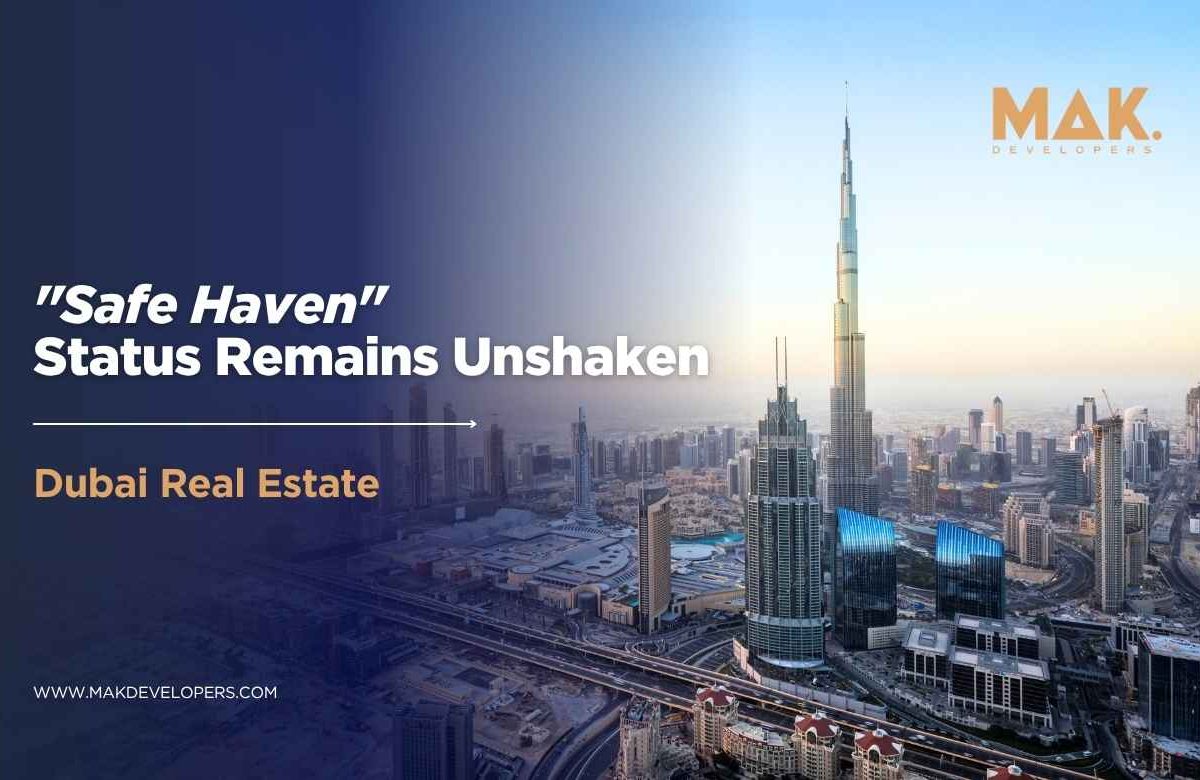
Dubai Real Estate 2026: Why the “Safe Haven” Status Remains Unshaken
The global economic landscape of 2026 is marked by a unique blend of technological acceleration and geopolitical shifts. Amidst this volatility, one market continues to stand as a beacon of stability: Dubai. For decades, the emirate has cultivated a reputation as a “Safe Haven” for capital, and as we move through 2026, this status is not just surviving—it is thriving. The Dubai real estate safe haven 2026 narrative is backed by more than just sentiment; it is grounded in record-breaking transaction volumes and a sophisticated regulatory framework that protects global investors.
In the first quarter of 2026 alone, the Dubai Land Department (DLD) reported a staggering Dh176.7 billion in transaction volume. This figure represents a significant milestone, proving that both institutional and private investors view Dubai as the ultimate destination for wealth preservation. While other global markets grapple with high interest rates and political uncertainty, Dubai’s property sector remains resilient, driven by a government-led vision that prioritizes growth, safety, and long-term residency.
The Resilience of Dubai’s Property Market Amid Global Volatility
The concept of a safe haven is often tested during times of regional or global tension. Historically, Dubai has shown a remarkable ability to decouple its economic performance from surrounding geopolitical noise. This resilience is a deliberate result of the “Switzerland of the Middle East” model—a diplomatic and economic strategy that positions the UAE as a neutral, stable ground for international business and trade.
Investors in 2026 are increasingly looking for markets that offer more than just capital appreciation; they are seeking a “currency floor.” Since the UAE Dirham is pegged to the US Dollar, property assets in Dubai effectively function as dollar-denominated investments. This provides a critical layer of protection against the currency devaluations seen in other emerging markets, making Dubai real estate safe haven 2026 a core strategy for wealth managers worldwide.
Historical Context: Lessons from Previous Cycles
To understand the current market strength, one must look back at how Dubai navigated previous global crises. Whether it was the 2008 financial crash or the 2020 pandemic, Dubai’s recovery was consistently faster and more robust than its peers. The 2026 market is fundamentally different from 2008; it is less leveraged, more regulated, and driven by a massive influx of high-net-worth individuals (HNWIs) who are choosing Dubai as their primary or secondary home.
Analyzing the Numbers: Dh176.7 Billion Q1 2026 Transaction Volume
The Dh176.7 billion recorded in Q1 2026 is not just a number—it is a vote of confidence. This volume represents a 23% increase compared to the same period in the previous year, highlighting a sustained upward trajectory. What is particularly noteworthy in 2026 is the balance between the off-plan and secondary markets. While off-plan demand remains high due to innovative developer offerings, the secondary market is seeing a surge in “end-user” buyers—people moving to Dubai to live, work, and stay.
| Market Segment | Q1 2026 Volume (AED) | YoY Growth | Key Driver |
| Off-Plan Properties | 98.5 Billion | 25% | New launches in Dubai South & Palm Jebel Ali |
| Secondary Market | 78.2 Billion | 21% | Increased demand for ready-to-move-in villas |
| Total Market | 176.7 Billion | 23% | Global capital flight to safety |
Institutional vs. Private Investor Confidence
We are seeing a significant shift in the profile of investors entering the market. In 2026, institutional funds from Europe and North America are increasing their allocations to Dubai real estate, drawn by the high rental yields which consistently outperform cities like London, New York, or Singapore. Simultaneously, private investors are utilizing the Dubai Golden Visa as a long-term anchor, ensuring their capital is parked in a tax-free environment with world-class infrastructure.
Why Dubai Real Estate is a Safe Haven in 2026
The “Safe Haven” status is built on three primary pillars: regulatory transparency, tax efficiency, and lifestyle quality. The Real Estate Regulatory Authority (RERA) has implemented stringent laws that protect off-plan buyers, including mandatory escrow accounts and developer accountability measures. This transparency is a major factor in the geopolitical impact on Dubai property, as investors from unstable regions prioritize legal security above all else.
Furthermore, the tax-free nature of property ownership in Dubai remains a massive draw. With zero capital gains tax and zero income tax on rental returns, the net ROI for a Dubai investor is significantly higher than in almost any other major global city. In 2026, as many Western nations consider increasing wealth taxes, Dubai’s fiscal policy remains a competitive advantage that is hard to ignore.
The Golden Visa: A Long-Term Anchor for Capital
The 10-year Golden Visa has been a game-changer for the Dubai market resilience 2026. By decoupling residency from employment, the UAE has encouraged property owners to view their investments as long-term commitments. This has led to a more stable market with fewer “speculative” flips and more “buy-and-hold” strategies, which naturally supports price stability even during global economic downturns.
Geopolitical Impact on Dubai Property: A Shift in Capital Flow
While regional tensions often cause concern, the actual impact on Dubai’s property market has historically been the opposite of what many expect. In times of uncertainty, capital tends to flow toward the safest and most stable point in the region. In 2026, we are seeing a “flight to quality,” where investors from across the Middle East, CIS countries, and Europe are consolidating their assets in Dubai.
This shift is particularly evident in the luxury segment. High-end villas and branded residences are seeing record demand, as UHNWIs seek privacy, security, and a high standard of living. The geopolitical impact on Dubai property in 2026 is characterized by this influx of “sticky capital”—money that enters the market and stays there because the owners have relocated their lives and businesses to the emirate.
Top Investment Areas for ROI and Stability in 2026
Choosing the right location is critical for maximizing ROI. In 2026, certain areas have emerged as leaders in both rental yields and capital appreciation.
| Area | Property Type | Avg. Rental Yield | 2026 Outlook |
| Dubai South | Apartments/Villas | 8.5% – 10% | High growth due to Al Maktoum Airport expansion |
| Jumeirah Village Circle (JVC) | Apartments | 7.5% – 9% | Consistent demand from mid-market professionals |
| Dubai Hills Estate | Villas/Townhouses | 6% – 7.5% | Premium family community with high capital gains |
| Palm Jebel Ali | Luxury Villas | 5% – 6.5% | Exclusive “trophy” assets with long-term value |
Conclusion: The Future Outlook for Dubai Investors
As we look toward the remainder of 2026 and beyond, the outlook for Dubai real estate remains overwhelmingly positive. The market has matured from a speculative hub into a sophisticated, global investment destination. The Dubai real estate safe haven 2026 status is not a temporary trend but a structural reality supported by visionary leadership, a pro-business environment, and a relentless focus on safety and innovation.
For investors, the message is clear: the window of opportunity in Dubai is defined by stability. Whether you are seeking high rental yields, capital preservation, or a long-term home for your family, Dubai offers a combination of benefits that few other cities can match. In a world of uncertainty, Dubai remains the unshaken safe haven.
Key Takeaways
- Record Volume: Q1 2026 saw Dh176.7 billion in transactions, a 23% YoY increase.
- Safe Haven Status: Driven by the USD-pegged Dirham, tax-free environment, and political neutrality.
- Golden Visa Impact: Long-term residency options have stabilized the market by encouraging “buy-and-hold” strategies.
- Institutional Growth: Global funds are increasingly allocating capital to Dubai due to superior rental yields (8%+ in key areas).
- Regulatory Safety: RERA’s stringent framework ensures high levels of investor protection and transparency.
FAQ:
1. Is Dubai real estate still a safe investment in 2026?
Yes, Dubai remains one of the world’s top safe havens due to its political neutrality, USD-pegged currency, and zero-tax policy on property income and capital gains.
2. What was the transaction volume in Dubai for Q1 2026?
The market recorded a historic Dh176.7 billion in transactions in the first quarter of 2026, reflecting strong investor confidence.
3. How does the Golden Visa benefit property investors?
The Golden Visa provides a 10-year residency, allowing investors to live, work, and study in the UAE without a local sponsor, which enhances the long-term value of their property investment.
4. Which areas in Dubai offer the best ROI in 2026?
Areas like Dubai South and JVC are currently offering some of the highest rental yields (up to 10%), while Dubai Hills and Palm Jebel Ali are leaders in capital appreciation.
5. How do regional tensions affect the Dubai property market?
Historically, regional uncertainty has led to increased capital flight into Dubai, as investors seek the safety and stability of the UAE’s “Switzerland of the Middle East” model.


